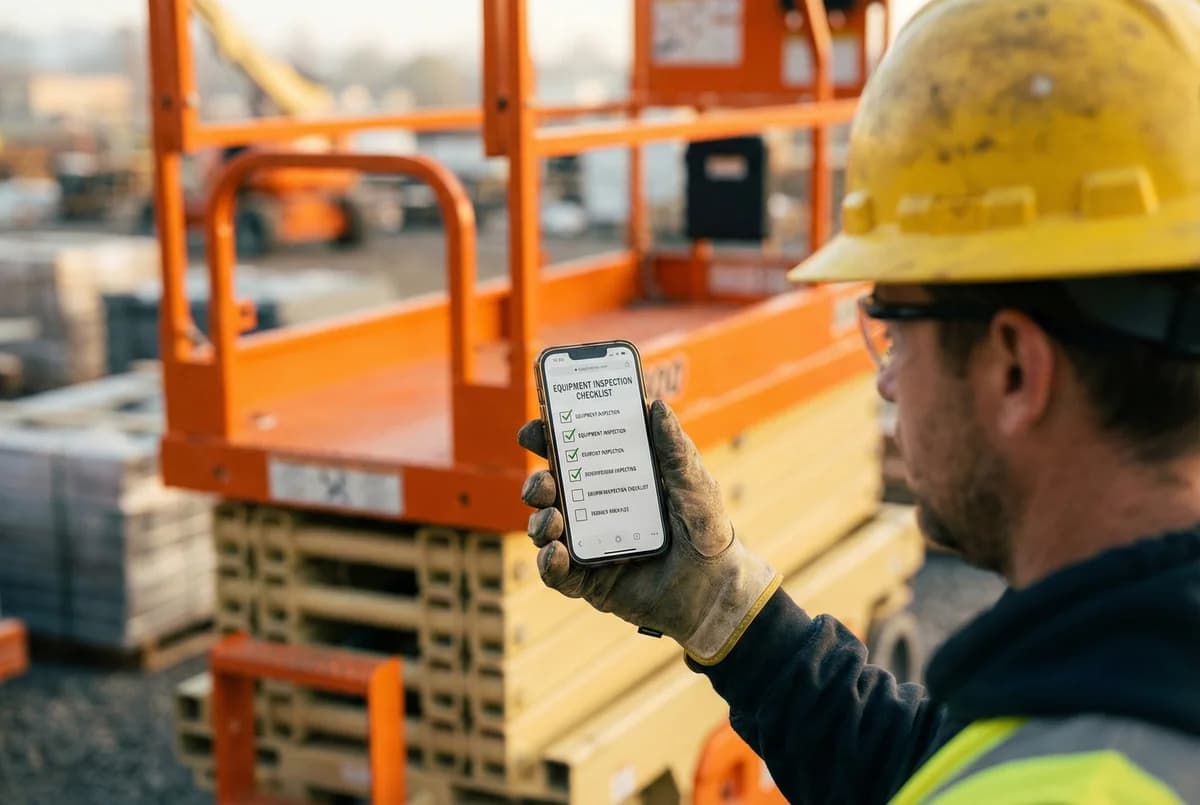
When Equipment Fails, Someone Asks: "Did It Pass Inspection This Morning?"
You require pre-use inspections in contracts. That doesn't mean they're happening. Or being documented. Or holding up in court.
Scaffold Collapses. Lift Malfunctions.
Worker gets hurt. OSHA shows up. First question: "Show me the pre-use inspection from today."
You call the foreman. He says: "Yeah, we inspected it. It was fine this morning."
Where's the documentation? Nowhere. Or scribbled on paper that's now missing.
Mid-Shift Breakdowns Cost You Days
Equipment breaks down at 2 PM. Crew sits idle. Schedule slips. Owner asks: "Why didn't you catch this during morning inspection?"
Because inspections were skipped. Or rushed. Or faked.
Reactive maintenance costs 10x more than catching issues early.
No Visibility Into Sub Equipment Condition
You manage 40 subs. 150 pieces of equipment across sites. Lifts, scaffolds, power tools, PPE.
Which subs are running degraded equipment? Which crews skip inspections?
You find out when equipment fails. By then it's too late.
The Equipment Defense Problem
When equipment causes injury, liability comes down to one question: Was it properly inspected? Contract language requiring inspections doesn't prove inspections happened. Timestamped, GPS-verified, photo-documented inspection records do.
How It Works
From pre-use inspection to documented equipment safety
Worker Selects Equipment Type
Before operating equipment, worker opens HazardHawk. Selects equipment type from library:
- Aerial lifts (scissor lifts, boom lifts)
- Scaffolding systems
- Power tools (saws, drills, grinders)
- Fall protection equipment (harnesses, lanyards)
- Heavy equipment (excavators, loaders)
Each equipment type has pre-configured inspection checklist. Based on OSHA standards and manufacturer requirements.
Complete Digital Checklist
Worker goes through inspection checklist item by item. Pass or fail for each component.
Photos required for:
- Overall equipment condition
- Any defects or damage found
- Serial number or equipment ID
If inspection fails: Equipment automatically locked out. Can't be used until remediation documented.
Creates Defensible Record
Completed inspection becomes permanent record with:
- Inspector name and digital signature
- GPS coordinates (proves on-site)
- Timestamp (proves when)
- Photos of equipment condition
- Pass/fail status for each checklist item
Failed inspections trigger corrective action workflow. Tracks remediation with photo verification. Documents when equipment returned to service.
Full maintenance history. Tamper-proof audit trail. Admissible in court.
Key Features
100+ Equipment Types
Pre-configured checklists for lifts, scaffolds, power tools, PPE, heavy equipment. Based on OSHA standards and manufacturer specs.
Required Photo Documentation
Photos of equipment condition with GPS and timestamp. Visual record proves condition at time of inspection. Can't be disputed.
Automatic Equipment Lockout
Failed inspection triggers lockout workflow. Equipment can't be cleared until remediation documented with photos. Enforces compliance.
Full Maintenance History
Track every inspection for every piece of equipment. See condition degradation over time. Identify patterns before failures occur.
Sub Compliance Scoring
See which subs consistently inspect equipment and which skip inspections. Inspection compliance rates by subcontractor and trade.
Degradation Alerts
Get notified when equipment shows repeated minor defects. Catch issues before critical failure. Proactive maintenance scheduling.
Digital Signature Capture
Inspector signs every inspection. Full accountability. When equipment fails, you know exactly who inspected it and when.
What You Hand OSHA When Equipment Causes Injury
This is how you prove due diligence—or shift liability to the sub
The Scenario
Scaffold collapses. Worker breaks leg.
OSHA investigator arrives.
First question: "Show me the pre-use inspection from this morning."
What You Produce
- Inspection record from 6:15 AM that morning
- Inspector name with digital signature
- Photos of scaffold condition before work started
- GPS coordinates proving on-site inspection
- Pass/fail status for each scaffold component
- Full maintenance history for that scaffold unit
Two Possible Outcomes
Scenario 1: Inspection Was Done Properly
Inspection passed all checks. Photos show no defects. Scaffold was properly erected. Failure was due to hidden manufacturing defect or worker error, not inadequate inspection. You demonstrate due diligence. Liability shifts away from GC.
Scenario 2: Inspection Was Skipped or Falsified
No inspection record exists. Or photos show obvious defects that should have failed inspection. Sub violated your requirements. You have documentation proving you mandated inspections. Liability shifts to the sub who failed to comply.
Either way, you have documentation that protects your firm.
Works With Your Existing Systems
Export to equipment management systems or PM platforms
Integration Options
- Sync with equipment management databases
- Export to Procore, Autodesk, Bluebeam
- API access for custom systems
- Automated maintenance scheduling integration
Or Standalone
Use HazardHawk as dedicated equipment inspection platform.
All inspection records in one place. Complete maintenance history. Easy OSHA export.
When incidents occur, export inspection records separately. Clean documentation that stands on its own.
Simple Pricing
Equipment inspection included in both tiers
For crew members who need to sign
- Digital signatures
- Sign inspection reports
- View assigned documents
Full access to all features
- Create equipment inspections
- Photo documentation
- All 7 document types
- PDF generation + digital sigs
- Team management
Common Questions
How long does an equipment inspection take?
2-5 minutes depending on equipment complexity. Simple power tools: 2 minutes. Aerial lifts or scaffolds: 5 minutes. Faster than paper checklists. Better documentation. Time well spent to prevent failures.
What happens if equipment fails inspection?
Equipment automatically locked out. Cannot be used until:
- Remediation completed and documented
- Photos of corrective actions taken
- Re-inspection passed
- Supervisor approval (if required by tier)
System enforces compliance. No shortcuts.
Can we create custom checklists for specialized equipment?
Yes! Safety Pro tier ($99/user/month) includes pre-built checklists for 100+ equipment types. These cover the most common equipment found on construction sites. Custom checklist creation is planned for future releases.
How do we track equipment condition trends over time?
Supervisor tier and above provides:
- Full maintenance history for each piece of equipment
- Condition degradation alerts when minor issues repeat
- Analytics showing which equipment types fail most often
- Identification of subs with poorly maintained equipment
Proactive maintenance prevents costly mid-shift breakdowns.
What if we don't have cell signal on-site?
Photos and inspection data can be captured and queued locally. GPS coordinates are recorded on device. When connection is restored, data uploads automatically and AI analysis is performed.