"We Didn't Think That Could Happen" Is Not a Legal Defense
OSHA requires Job Hazard Analysis for high-risk activities. Most GCs mandate JHAs in contracts. But mandating and proving are two different things.
Incident During High-Risk Work
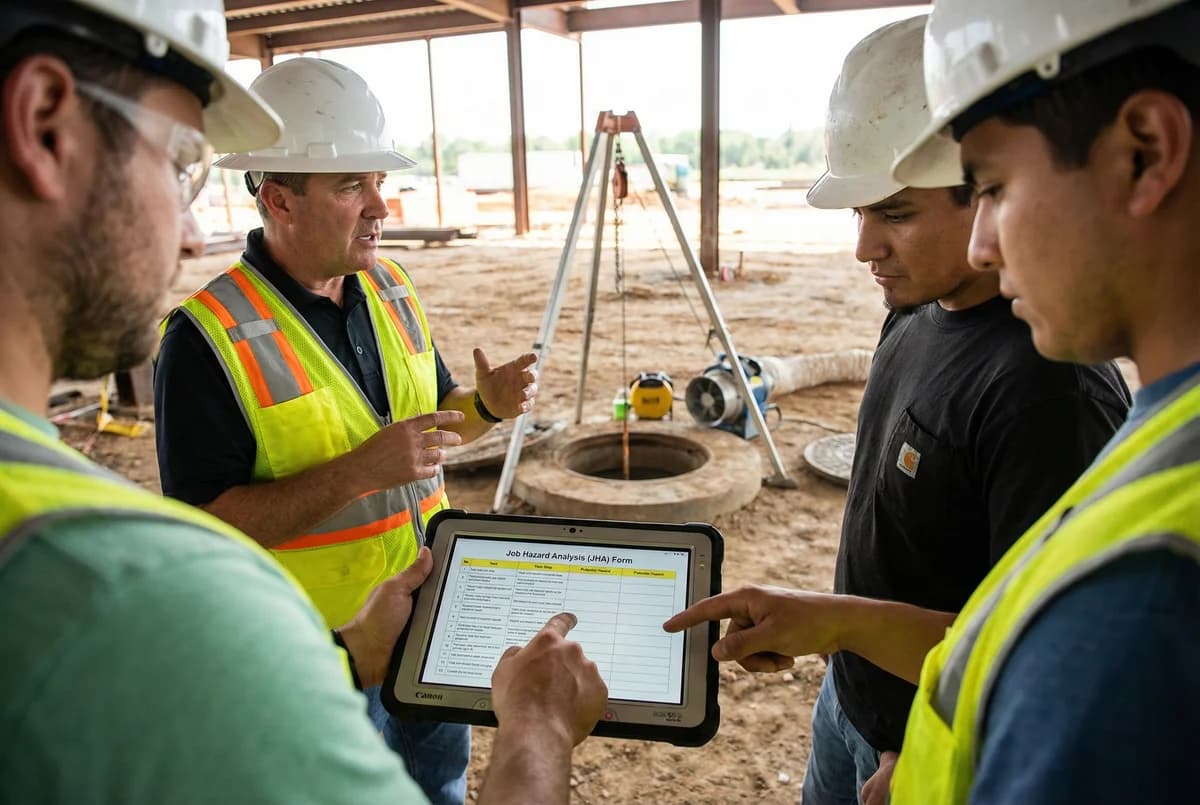
Worker injured during confined space entry. OSHA investigator arrives. First question: "Where's the Job Hazard Analysis?"
You call the foreman. He says: "We talked about it. Everyone knew the risks."
Where's the documented analysis? Nowhere. Or scribbled notes that don't prove systematic review.
No Systematic Methodology
Subs create JHAs because you require them. Generic templates copied from the internet. Hazards listed without thought. Controls assigned without verification.
Then the hazard they missed is exactly what causes the injury.
OSHA investigator: "This JHA didn't identify the actual hazard that caused injury. It's worthless."
Zero Visibility Into High-Risk Work
40 subs across 15 projects. Confined space entries. Hot work permits. Crane lifts. Excavations. Demo work.
How many high-risk activities are happening today? Which subs completed JHAs?
You find out when the incident makes the news.
The JHA Documentation Gap
OSHA doesn't accept "we required JHAs in the contract" as evidence of compliance. They want to see the actual documented analysis. With signatures. With timestamps. With evidence that systematic hazard review occurred before work began.
How It Works
From high-risk activity identification to documented safety analysis
System Flags High-Risk Activity
When crew plans high-risk work, system triggers JHA requirement. Configurable triggers for:
- Confined space entry
- Hot work (welding, cutting, torch work)
- Crane lifts and rigging operations
- Excavation deeper than 4 feet
- Demolition work
- Work at height above 6 feet
Dashboard alerts GC when high-risk activity is scheduled. Work cannot proceed until JHA completed.
AI-Assisted Task Breakdown
System guides crew through systematic analysis. Step-by-step methodology:
- Break task into individual steps
- AI suggests hazards for each step based on OSHA standards
- Crew adds task-specific hazards AI missed
- System flags high-risk steps requiring extra attention
AI does the heavy lifting. Crew adds site-specific knowledge. Creates comprehensive analysis.
Assign and Verify Controls
For each identified hazard, crew documents control measures. AI suggests controls based on hierarchy:
- Elimination (remove the hazard)
- Substitution (replace with safer alternative)
- Engineering controls (physical barriers, ventilation)
- Administrative controls (procedures, training)
- PPE (last line of defense)
Pre-work verification checklist ensures controls are in place before work begins.
Photo documentation of controls. Crew signs verification. Creates defensible record.
- Continuous atmosphere monitoring (4-gas detector)
- Forced ventilation system operating
- SCBA available for emergency rescue
Key Features
Configurable High-Risk Triggers
Set project-specific triggers for JHA requirements. System automatically flags high-risk activities. Work cannot proceed without completed JHA.
AI Hazard Suggestions
AI analyzes task and suggests hazards based on OSHA standards and industry best practices. Reduces "we didn't think of that" scenarios.
Step-by-Step Methodology
Guided workflow ensures systematic analysis. Task breakdown, hazard identification, control assignment. Creates defensible documentation.
Pre-Work Verification
Verification checklist ensures all controls are in place before work begins. Photo documentation of control implementation. Crew signs off.
Portfolio-Wide Visibility
Real-time dashboard shows high-risk activities across all projects. See which subs completed JHAs. Track compliance by subcontractor.
JHA Library & Standardization
Build library of JHAs for common high-risk tasks. Share across projects. Standardize approaches across trade partners. Learn from past analyses.
Digital Signatures & Timestamps
Crew signs JHA before work starts. Supervisor approves. GPS and timestamp verification. Creates tamper-proof audit trail.
What You Hand OSHA After High-Risk Work Incident
This is how you prove systematic hazard analysis occurred before work began
The Scenario
Worker injured during confined space entry. Hydrogen sulfide exposure.
OSHA investigator arrives: "Show me the Job Hazard Analysis for this confined space entry."
Worker claims: "We didn't know H2S was a hazard. Nobody told us to test for it."
What You Produce
- Completed JHA from morning of incident (6:30 AM)
- Step-by-step task breakdown documented
- "Toxic gases including H2S" listed as identified hazard
- Required controls: "4-gas detector with H2S sensor, continuous monitoring"
- Pre-work verification checklist showing controls confirmed
- Worker's signature on JHA at 6:45 AM
- Photos of atmospheric testing equipment in use
OSHA Investigator Response:
"The JHA clearly identified H2S as a hazard. Required controls were documented. The worker signed acknowledging the hazards and controls. If the worker didn't follow the documented procedures, that's on them, not you."
Zero citations for inadequate hazard analysis. Worker's claim of "not knowing" contradicted by his own signature on the JHA. Defense protected.
Systematic documentation protects you when workers don't follow documented procedures.
Works With Your Existing Systems
Export to PM platforms or keep as standalone safety documentation
Integration Options
- API integration with Procore, Autodesk, Bluebeam
- Export to project management systems
- Automated daily JHA summaries
- SharePoint or Google Drive sync
Or Keep Separate
Many GCs prefer dedicated safety documentation platform. Clear separation from project management.
All JHAs in one place. Searchable library. Easy OSHA export.
When incidents occur, export complete JHA package. Professional. Complete. Defensible.
Simple Pricing
JHA creation included in both tiers
For crew members who need to sign
- Digital signatures
- Sign JHAs & reports
- View assigned documents
Full access to all features
- Unlimited AI hazard analysis
- AI-assisted JHA generation
- All 7 document types
- PDF generation + digital sigs
- Team management
Common Questions
How long does it take to create a JHA?
15-20 minutes for most high-risk tasks. AI suggests task breakdown and hazards, reducing manual work. Crew adds site-specific details. Pre-work verification adds 5 minutes. Total: 20-25 minutes to create comprehensive, defensible JHA. Compare to generic templates that take 10 minutes but provide zero legal protection.
How accurate are AI hazard suggestions?
AI trained on OSHA standards, industry best practices, and real incident data. Identifies 80-90% of common hazards for typical high-risk tasks.
Crew always reviews and adds site-specific hazards AI might miss. AI handles systematic analysis. Crew adds local knowledge.
Together: comprehensive hazard identification that stands up to OSHA scrutiny.
Can we standardize JHAs across our subcontractor network?
Yes. Supervisor tier and above includes JHA library.
- Create standard JHAs for common high-risk tasks
- Share across projects and subs
- Subs customize for site-specific conditions
- Learn from best analyses across your portfolio
Consistency without sacrificing site-specific adaptation.
What if work conditions change after JHA is completed?
Stop work. Update JHA with changed conditions. Document new hazards and controls. Crew signs updated JHA.
System tracks all revisions with timestamps. Shows when conditions changed and how analysis was updated.
Full audit trail proves you adapted to changing conditions. Not locked into outdated analysis.
How do we track which subs complete JHAs for high-risk work?
Supervisor tier dashboard shows:
- All high-risk activities scheduled across portfolio
- JHA completion status for each activity
- Which subs consistently complete JHAs
- Alerts when high-risk work scheduled without JHA
Proactive enforcement. Know before work starts whether JHA was completed.